
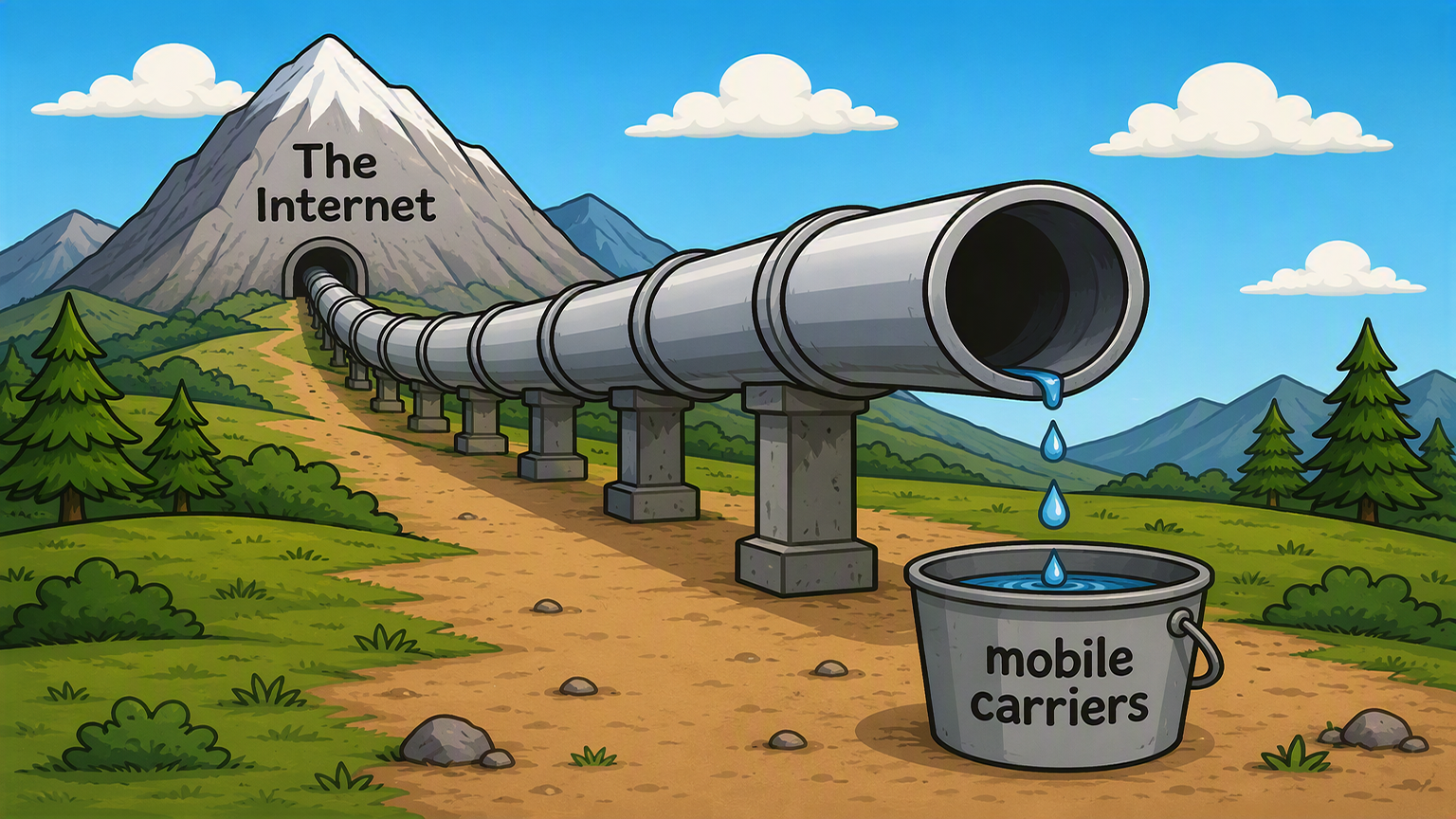
Way back in time, in 2008, when 3G was mature enough to promise significant data – and service – opportunities, the CEO of Vodafone, Arun Sarin, famously said that carriers “must not allow ourselves to become big pipes and let someone else do the services.” Softbank’s CEO, Masayoshi Son was more succinct, saying that operators risked becoming “dumb pipes”. Fast forward 18 years and the carriers have, indeed, focused their efforts on becoming bigger (and faster) pipes and while one could argue that these pipes are anything but dumb, the outcome is as they feared: they provide the pipe for other people’s apps and services.
“Dumb” pipes still make money: the top three carriers made roughly $50 billion profit in 2025, so the initial concern from Vodafone et al did not come to pass. But what it has meant is that carriers cannot differentiate based on the services running over the network… which frankly is probably for the best when it comes to the fast pace of Internet-era innovation.
However, while the carriers were fretting about dumb, faster pipes, another threat has played out: boring commoditization. Back in 2008, the carriers could differentiate based on the phones that they offered. An exclusive device deal could give a particular carrier a short-term upper hand. Cingular, for example, was the first to offer the iconic Motorola Razr and, most importantly, had an exclusive deal for the original iPhone. People chose the carrier not for the price of the pipe (I know, the carriers like to call it “service) but because they wanted a specific phone. Price of service was still important… but was often not the deciding factor.
And then the world turned. The smartphone market proved to be a viscous world where only the few could survive. LG and Nokia, two stalwart believers in quirky phone designs, both fell out of the market, while Apple and Samsung become the devices of choice. They are responsible for roughly 85% of the smartphones owned by Americans today. That’s not great for the carriers who need some form of differentiation to drive customer growth, but at least the carriers managed to hold onto the retail experience… until now.
Apple’s Upgrade program – and presumably other manufacturers will be considering similar programs – puts the carrier’s grasp of the consumer further at risk. The carriers will find it increasingly difficult to tempt consumers to their service based on compelling device offers (switch over and get a “free” phone type offers). And that’s before we consider the implications of BYOD and certified pre-owned devices that consumers are increasingly choosing – yet another carrier-independent purchase that reduces the carriers leverage over the consumer
At the same time, the networks have become ubiquitous across most of the country. There will always be some areas that offer varying levels of quality across the carriers, but that is where satellite backup can fill the gap.
With networks almost the same, device variety limited and device pricing now in competition with the device manufacturers themselves, the carriers appear to be left with three final competitive levers: adding free services such as streaming TV (something that all carriers are engaged in to varying degrees), bundling pipes with the combination of landline and mobile and, of course, pricing of the dumb pipe itself. The latter two are the very things that the industry was concerned about in 2008; it doesn’t matter if it’s a pipe to the home or to the smartphone, the industry still runs the risk of a race to the bottom.