
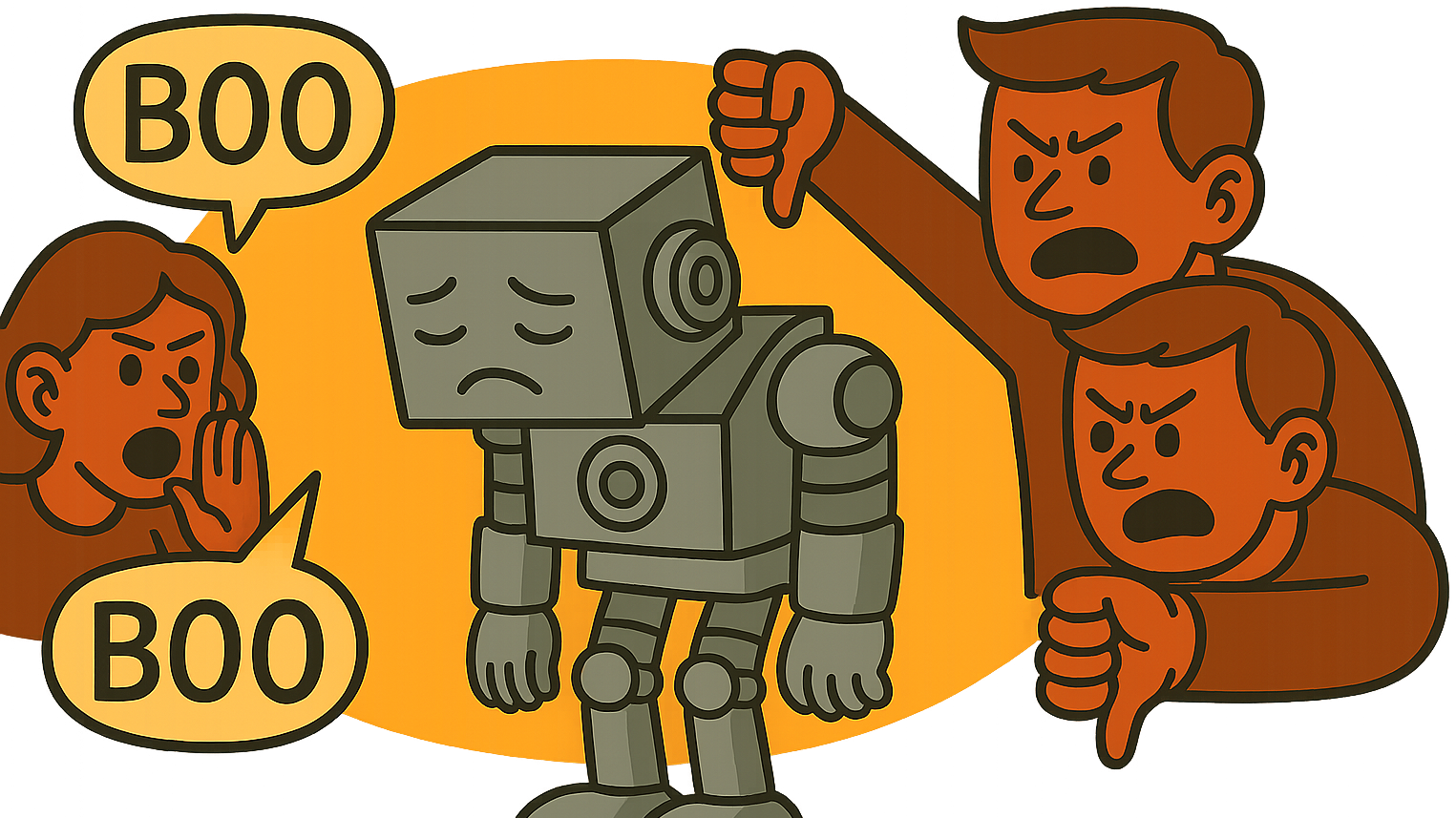
“I’ve watched The Terminator and know how this ends.”
Survey respondent June 2026
In March 1811, a group of angry British workers led by a figure known as “General Ludd” attacked a factory near Nottingham. The purpose was to destroy the new mechanized looms (to make socks and stockings) that the workers believed would take their jobs. And so began the short-lived workers revolution and the long-lived term “Luddite”, thrown out as an insult by some, worn with pride by others, to describe anyone with a resistance to new tech. Never has it been a more relevant term than now, as AI rapidly shifts from decades of theoretical possibilities to a very real technology that will either save – or destroy – the world, depending upon your point of view.
The so-called” tech-lash” is very real: student graduation ceremonies include almost ritualistic booing of any AI reference and Google’s recent integration of more AI into its search functionality drove a 38% increase in use for Europe’s non-AI search engine, Duck-Duck-Go. And so, this blog is for the Luddites; the 35% of consumers who do not use Agentic AI for a variety of reasons according to our upcoming Evolving Ecosystem report.
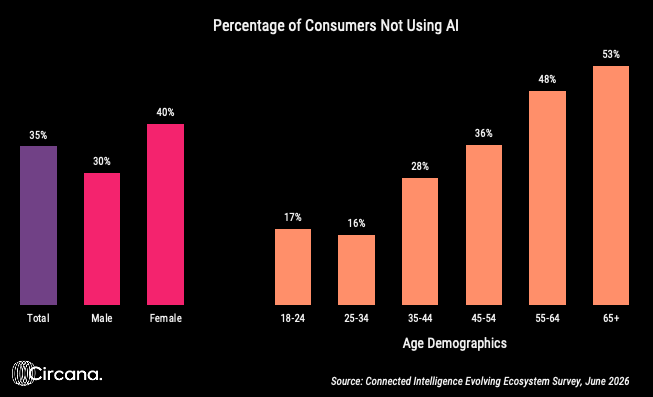
First, it’s important to understand just who these users are. Despite a clamoring of news stories about younger audiences complaining about AI, in general, the conscientious objectors increase with age. Those graduating students protesting at their ceremony should be just 17% of the audience and perhaps – just perhaps – 17% of graduates didn’t use ChatGPT or the like to help earn their graduation seat. But now they are entering the job market, these same students view AI as a job-stealing risk, while also being a tool that can help possibly get to the interview stage. Talk about a double-edged sword.
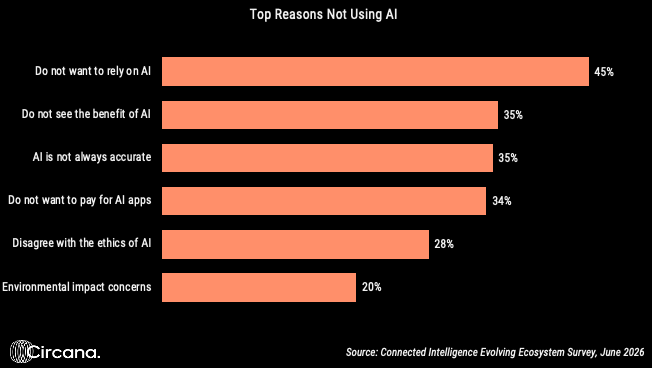
But while we noted that, overall, just 17% of the younger consumers avoided AI, this same audience pops significantly higher on some of the key objections. Environmental concerns regarding AI – those thirsty data centers in particular – is a concern for 20% of the non-AI users, but among consumers 45 or younger, the issue scores almost double, with 38% citing it as a major concern. Conversely, concerns about relying too much on AI rank lower (34%) among under 25 year olds compared to a peak of 40% among 25-45 year olds.
One challenge is just how AI is marketed and positioned, with companies aggressively highlighting AI as a product rather than an integrated set of features within current products. The hype machine surrounding AI is focused on boosting company valuations, not on convincing consumers of the many benefits of the technology. Take the inclusion of AI into search as an example: as mentioned above, Google’s announcement of this at its annual tech-fest drove a 38% increase in Duck-Duck-Go signups. But using AI to improve search results should be a good thing if done well… perhaps with an option for consumers to opt out of the AI component if they so desire. The same can be said for voice assistants – Siri, Hey Google, Alexa and more. The product should remain the same from a consumer perspective… it just (theoretically) works better; an incremental improvement that consumers appreciate, rather than a new product that some consumers view with distrust.
But the distrust is real, fueled to a great extent by the blunders of various AI machines still learning to distinguish between good, and poor, sources of data. The UK’s BBC recently published a study that showed AI news queries were incorrect nearly 45% of the time. One major cause of the mind-blowingly high failure rate was that the AI pulled from sources that were of questionable quality and accuracy, creating an alternative history of sorts via the AI machine. Then, of course, there are the infamous Grok holocaust-denial results, to name and shame just one of the many AIs that has blundered dramatically. It used to be said that history was always written by the victors: the worry now is that history will be overwritten by the AI and its owner.
Less hype (admittedly, it’s hard to squeeze that genie back into the bottle) and more focus on product improvements will help drive further AI acceptance – or at least reduce resistance to the tech. One core objection that survey participants highlighted was that they preferred not to rely on AI for their thoughts and answers. I would argue the human race lost that battle when the Internet first went mainstream – and particularly with the mass adoption of social networks. AI is simply the next iteration of that theme and it’s up to the people to decide what level of adoption they will embrace.
The Luddites are not necessarily wrong about any of their concerns. But at the same time, technology moves forwards relentlessly. After all, we all own socks or stocking that were made on a modern-day loom. The difference between that particular battle and the current one is that a sock is, pretty much, just a sock: it may wear out sooner (or last longer) when machine made, but you can trust your eyes that it is what it claims to be. With agentic AI, a healthy approach is to adopt varying degrees of distrust when the machine spits out the answers. That’s not a bad thing… and should apply far beyond any AI machine.
The next blog will focus on the 65% of consumers who do use AI . The data cited in this blog is a small component of the Connected Intelligence annual Evolving Ecosystem Report.