
Samsung broadens its foldable lineup with new Galaxy Z Fold 8 series
Samsung unveiled its latest generation of foldables at its July Unpacked event in London, introducing the Galaxy Z Fold 8 Ultra, Galaxy Z Fold 8, and Galaxy Z Flip 8. The launch marks the first time Samsung has offered three foldable smartphones simultaneously, expanding the category beyond the traditional Fold and Flip form factors. The Galaxy Z Fold 8 Ultra succeeds the Fold 7 as Samsung's flagship productivity-focused foldable, while the all-new Galaxy Z Fold 8 introduces a wider, passport-style design with a shorter cover display and a more tablet-like internal screen. The Galaxy Z Flip 8 receives iterative upgrades while continuing to target consumers seeking a compact, pocketable foldable experience. Across the lineup, Samsung highlighted deeper integration of Galaxy AI and Gemini-powered features, along with incremental improvements in durability, battery life, and display technology.
The new devices carry higher price tags than their predecessors. The Galaxy Z Fold 8 Ultra starts at $2,099, the Galaxy Z Fold 8 starts at $1,899, and the Galaxy Z Flip 8 starts at $1,199. The phones became available for preorder on July 22 and are scheduled to begin shipping on August 7. As with prior Galaxy flagship launches, Samsung is offering promotional incentives including trade-in offers and free storage upgrades for early buyers.
The Circana Take:
- The new Galaxy Z Fold 8 was undoubtedly the star of Samsung’s launch event, thanks to its new passport-style form factor. The wider aspect ratio delivers a more natural viewing experience when unfolded, making content consumption and multitasking more intuitive. While the slightly wider closed profile may require some adjustment for existing Fold users, it is unlikely to pose an issue for former Galaxy Note users who are already accustomed to wider device footprints.
- With the introduction of the upgraded Galaxy Z Flip 8, Galaxy Z Fold 8, and Galaxy Z Fold 8 Ultra, Samsung has effectively checked every box from a foldable form factor perspective, offering the industry's most comprehensive portfolio. The Flip series continues to resonate strongly with style-conscious consumers, particularly women, while the Fold Ultra is designed for power users seeking enhanced productivity and multitasking capabilities. The new Fold 8’s passport-style design strikes a more balanced approach, making it largely gender and style agnostic and potentially the most broadly appealing foldable in Samsung’s lineup.
- The Galaxy Z Fold 8’s passport-style form factor closely mirrors the design rumored for Apple’s first foldable iPhone. By bringing this form factor to market ahead of Apple, Samsung strengthens its ability to retain existing Galaxy users who may otherwise have been tempted to switch ecosystems in pursuit of a similar design experience. In effect, Samsung is proactively addressing a potential migration risk before Apple formally enters the category.
- As innovative as Samsung’s latest foldable lineup may be, the company should not expect significant gains from iPhone users. Apple’s customer base remains exceptionally loyal, particularly among postpaid subscribers, where loyalty rates approach 95%. Moreover, the relatively small number of Apple defections seen in recent years have largely been driven by consumers seeking foldable form factors unavailable within Apple’s portfolio. Once Apple enters the segment, Samsung’s opportunity to attract iOS switchers may become more limited.
- Circana’s Mobile Connectivity research continues to indicate strong interest in foldables among affluent Android consumers. Samsung’s new lineup, particularly the redesigned Galaxy Z Fold 8, should resonate with premium Android smartphone users, especially those on high-end postpaid plans. Aggressive carrier promotions and attractive trade-in offers are likely to further support adoption among flagship device owners of other Android brands.
- While Samsung’s premium pricing remains a potential barrier, carrier financing programs help mitigate the upfront cost for many consumers. In practice, carriers absorb much of the device subsidy and recover those costs through higher monthly service revenues. As a result, adoption is likely to be strongest among customers on premium postpaid plans, while users on legacy service plans and BYOD arrangements may remain more hesitant. However, the extension of device financing terms to as much as 48 months, such as Verizon’s current offering, could meaningfully improve affordability and broaden access to these higher-priced foldable models.
Apple launches the long-awaited Apple Upgrade leasing program
Apple announced Apple Upgrade, a new leasing program available through the Apple Store online, the Apple Store app, and Apple retail stores across the United States. Offered in partnership with Klarna, the program allows customers to lease iPhone, Apple Watch, iPad, and Mac devices through monthly payments rather than traditional financing or outright purchase.
Apple Upgrade offers 12- and 24-month lease terms for iPhone and Apple Watch, and 24- and 36-month lease terms for iPad and Mac. Monthly payments start at $17.99 for iPhone, $11.99 for Apple Watch, $11.99 for iPad, and $24.99 for Mac.
For iPhone leases, the program is currently limited to Apple’s latest iPhone lineup, including the iPhone 17, iPhone 17 Pro, iPhone 17e, and iPhone Air. Customers are required to activate their device with an eligible U.S. postpaid carrier (AT&T, T-Mobile or Verizon) during the purchase process. The requirement limits the availability of unlocked devices through the program and helps ensure that leased devices remain associated with supported U.S. carrier accounts.
Customers can reduce their monthly payments through Apple Trade In and earn 3% Daily Cash on payments made with Apple Card. At the end of the lease term, customers can upgrade to a newer device, purchase their current device with a one-time payment, or return the device and exit the program.
The Circana Take:
- It is no secret that Apple, like every major smartphone brand, has been challenged by slowing device sales as consumers continue to extend their upgrade cycles. Despite manufacturers' aggressive innovation efforts, consumers still place greater emphasis on core attributes such as battery life, reliability, and overall value rather than novelty-driven features. Apple’s new leasing program is designed to encourage more frequent upgrades, and its relatively affordable monthly payments, combined with 12- and 24-month lease options, could help shorten replacement cycles among existing iPhone users.
- According to Circana’s Mobile Consumer Tracking Database, Apple retail and online channels account for roughly 15% of all postpaid smartphone transactions. As a result, the new leasing program is unlikely to have a seismic impact on the overall market in the near term. However, as carriers continue to increase their focus on BYOD customers through targeted plans and promotional offers, Apple’s share of upgrade transactions could grow as more consumers turn to Apple channels for a lower-barrier path to obtaining a new iPhone.
- The new program is currently limited to customers activating service with the nation’s largest postpaid carriers, leaving prepaid subscribers on the sidelines. While this decision is understandable, particularly from a credit risk perspective, it limits Apple’s reach among value-conscious consumers. A leasing option tied to more affordable devices such as the iPhone 17e could have been particularly effective in attracting higher-value prepaid customers, including those on premium plans from providers such as Metro and Mint Mobile.
- The leasing program could prove especially valuable for Apple as it prepares to introduce its first foldable iPhone, a product that industry rumors suggest could carry a price tag approaching $2,500. Many iPhone users who are unwilling to commit to expensive premium carrier plans in exchange for device subsidies may view Apple’s leasing option as a more flexible way to experience a first-generation foldable device. The ability to lease, evaluate the product, and potentially upgrade to a future iteration could help reduce adoption barriers. It is worth remembering that Samsung required more than five generations of foldables before arriving at its current level of design maturity and durability.
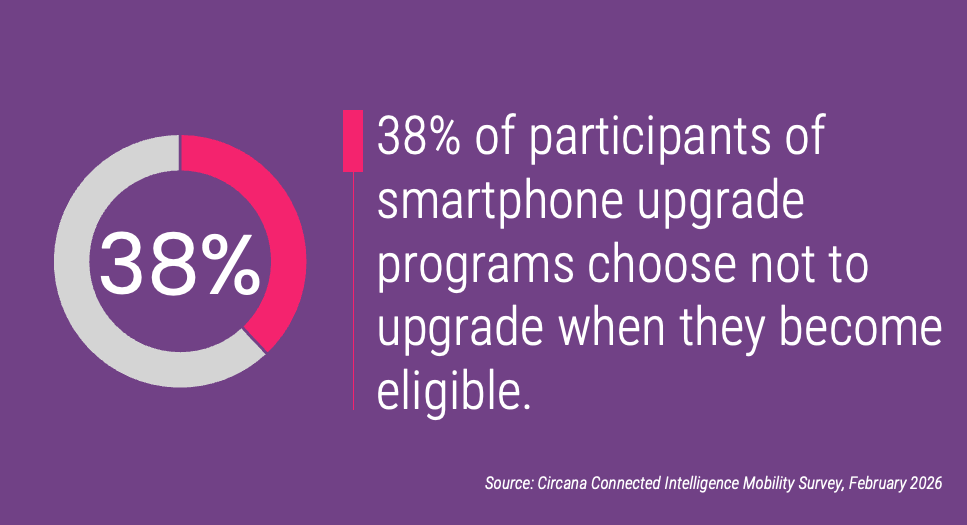
- U.S. consumers may be relatively unfamiliar with smartphone leasing programs, aside from Sprint’s short-lived leasing initiatives, but they are highly familiar with upgrade programs. According to Circana’s Connected Intelligence Mobility survey, roughly half of iPhone users participate in some form of upgrade program, either through their wireless carrier or directly through Apple. Notably, nearly 40% of eligible participants choose not to upgrade when they become eligible, often because of incremental costs such as taxes, activation fees, and other out-of-pocket expenses. While Apple’s leasing program may appear attractive on the surface, consumers will eventually recognize that frequent upgrades still carry meaningful costs beyond the monthly lease payment.
- U.S. postpaid carriers should largely welcome Apple’s leasing initiative, as it could help reduce some of the financial burden associated with device subsidies. While subsidies remain an effective tool for locking in subscribers and reducing churn, BYOD customers who subscribe to bundled services, such as wireless and home internet, already exhibit relatively low churn propensity. The Apple leasing program may provide these customers with a pathway to more frequent flagship iPhone upgrades without requiring carrier-funded hardware incentives.
- As highlighted in Circana’s latest Certified Pre-Owned Smartphone market report, the supply of refurbished smartphones has been tightening as consumers hold onto their devices longer and carriers scale back trade-in incentives. Apple’s new leasing program should help replenish the supply side of the secondary market by creating a more predictable stream of returned devices. This additional inventory comes at a time when demand for refurbished smartphones is increasing, driven in part by higher new device prices and ongoing component cost pressures. However, Apple is expected to be the primary beneficiary of this increased supply, as the company retains greater control over returned devices and can monetize a larger portion of the trade-in inventory through its own refurbishment and resale channels.
- If Apple’s leasing model proves successful, it could encourage U.S. carriers to consider similar lease-based device programs, similar to those commonly found in Canada. Canadian carriers increasingly embraced leasing models after regulatory changes required smartphones to be sold unlocked, creating new incentives for carriers to retain customers through flexible financing and device return programs rather than through long-term hardware ownership.