
Google launches Whoop competitor
Google has launched the Google Fitbit Air, entering what we consider to be a rather niche market with a dual-branded (Fitbit and Google?) product. But while the product looks a lot like that of Whoop – a screenless band chuck full of sensors – there’s one key difference: Whoop gives the band away for free and makes its money on the service; Google is charging for the band and giving the data analysis away for free (at least for now). And at just $99, Google’s product is significantly below the price of both Whoop (if you were to buy the hardware only) and any half-decent smartwatch.
To the details: it’s a screenless device that snuggles inside a writ band (or a chest band or any other attachment you may desire). It is essentially a Fitbit, free of the standard case, but is also smaller than any previous Fitbit that we can think of. Without a screen to power, the device has a long battery – Google says about a week – which makes it more practical for sleep tracking as well and all-day use. Your data gets pulled into Google Health Coach which is a Gemini-powered interface to give you personalized advice based on your data. It will also create fitness plans based on your goals and monitor your progress.
The Circana Take:
- Priced at $99, this product undercuts most – if not all – smartwatches and fitness trackers that most consumers would consider. Of course, you are sacrificing the screen and buying a product that is purely fitness/health focused, rather than any of the other benefits of a smartwatch (alerts, messages, etc)..
- The pricing could backfire on Google, a company that is renown for mining all the data it possibly can. While the company stressed in the announcement that your data is “private and secure” people may view the price as too little for a product that does not create a second revenue stream from the data somehow.
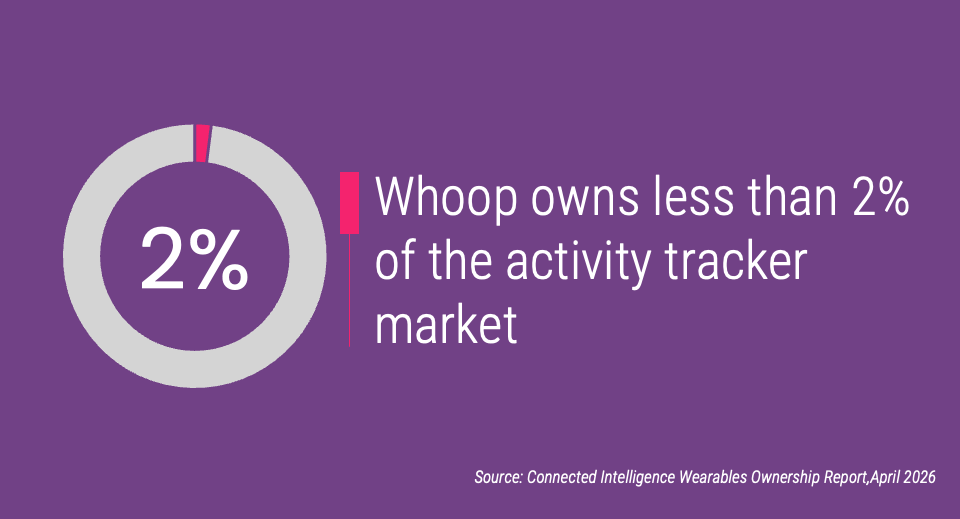
- The screenless fitness tracker market is a niche at this time. We estimate that Whoop has less than 2% share of the fitness tracker market and we are not convinced that Google’s new Fitbit Air will significantly increase the size of the market. Perhaps a fairer way to look at the opportunity is as a competitor to smart rings (essentially the same device but in a ring rather than wristband format). But as we recently talked about in our latest blog (Ever Decreasing Circles of Influence?) smart rings are typically bought by consumers who also wear a smartwatch.
- And finally, Whoop is positioned as a rather elitist device: sports people and senior execs who really care about their health, but who still have a nice watch they want to wear. That is not where Fitbit’s brand sits today (although it’s obviously a key reason for brand ambassador Steph Curry).
Whoop ups the stakes
Whoop has added a raft of new features to its service including live, on-demand video consultations with license clinicians through the Whoop app. The medical professionals will be able to access to consumer’s Whoop health history, as well as their full medical records if they wish to make use of the HealthEx partnership. In other words, while Google has focused on AI, Whoop has gone old-school. That’s not to say Whoop is ignoring AI: the company has added a new AI feature called “My Memory” that lets users add personal context to the coaching recommendations provided by Whoop to ensure any coaching takes into consideration the user’s life circumstances.
The Circana Take:
- Whoop’s move is clever. As we mentioned above in the Google Fitbit Air take, Whoop is positioned as a rather elitist device. And nothing says “you are special” as much as access to real life, caring physicians rather than an AI-infused app.
- While much will be made of the similarities of the Fitbit Air to Whoop, the reality is that they are products aimed at very different demographics. That’s the key message from Whoop’s new announcement.